Hauntings at Elvaston Castle
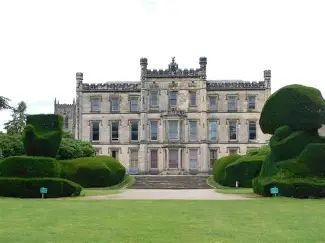
Elvaston Castle is said to be haunted by four ghosts. What ghosts I hear you ask? Well I'm about to tell you, don't worry your pretty heads! First though, a little history:
Elvaston Castle is a stately home in Elvaston, Derbyshire. It is a big, gothic revival castle and it and its surrounding parklands are looked after by Derbyshire County Council. The country park has 200 acres of woodlands, parkland and formal gardens. Up until the 16th century the estate was held by the Shelford Priory. After the Dissolution of the Monasteries the Crown sold the priory and its estates in 1538 to Sir Michael Stanhope of Rampton, Nottinghamshire. Sir John Stanhope (died 1611) granted the estate to his second son also Sir John Stanhope (died 1638) High Sheriff of Derbyshire, in 1629. The manor house was built for the latter Sir John in 1633. This Elizabethan-style house was redesigned and extended in a grand Gothic Revival style by James Wyatt in the early 19th century for Charles Stanhope, 3rd Earl of Harrington. Wyatt designed a new wing, a new great hall, and most of the interiors of the castle, but died before work was completed. His designs were carried out by Robert Walker between 1815 and 1829.
Further modifications were made in the 1836 by the architect Lewis Nockalls Cottingham; this work was on the Elizabethan-styled south front which was remodelled to match the rest of the now Gothic-styled castle.
In 1860–1861 there were further alterations. The Earl of Harrington contracted alterations carried out by Robert Bridgart's building company of Friar Gate Derby under the direction of Messrs Giles & Brookhouse, architects. Both newspaper articles have lengthy descriptions of all the alterations. Robert Bridgart died in 1860 during the alterations and his son (Robert Bridgart of Derby) took over the building works.
During World War II, the house was turned into a teacher training college after the original college in Derby was evacuated.
The college vacated the house in 1947, after which time it remained mostly empty for the next two decades until its sale, starting a steady decline that continues to this day.
Now onto the hauntings:
Elvaston Castle is said to be haunted by four ghosts. The first is the mysterious 'Grey Lady' whose identity is not known but is said to have been seen sitting in what appears to be a rocking chair, rocking backwards and forwards while looking out of one of the castle windows. The second is a 'White Lady', thought to be Maria Foote, wife of the 4th Earl. She it seems is often witnessed with a forlorn, longing look on her face and walking the grounds with a white 'wolfhound' looking dog. Ghost number three is that of an 18th century scullery maid who is said to have found herself pregnant by one of the Earl's friends and committed suicide.The 4th and most ill tempered ghost is thought to be that of an old gamekeeper James Booth who is said to haunt the Orchid House in the castle's atrium. He has been known to jam doors and then pull them out of people's hands, apparently annoyed at their intrusion into the building.
Finally, The Happy Huntsman Story:
"Family lore says that when Charles was buried, the hounds bounded into the graveyard and gathered around the oak tree near the family crypt.
They would not leave and could not be coaxed away."
February 5, 1917
On this day, the Happy Huntsman's Tree was planted, which stands beside the Harrington family crypt near Elvaston Castle, a stately home in Elvaston, Derbyshire, England.
The Happy Huntsman's Tree is an Oak tree that honors the 8th Earl of Harrington - Charles Augustus Stanhope, who died on this day at 73.
When he died, Charles was one of the largest landowners in England, with estates totalling over 13,000 acres.
Charles was the first business person to open a store in London under his name.
Selling fruit from his garden, his store closed after a few seasons.
Gardeners would be delighted by his home at Elvaston Castle, which was settled among the most magnificent topiaries.
Trees, shrubs, and hedges were fashioned into men, animals, pyramids, and fans.
Even though one of his arms was useless, Charles was an active person.
He was one of the pioneers of polo in England, and he also played as an old man.
Charles was an avid Huntsman.
He was a master of the South Knot Hunt for over 30 years.
During hunting season, he hunted six days a week.
His obituary said that he never missed a hunt unless he happened to be laid up with broken bones from a fall.
At Elvaston Castle, there was a little workshop where Charles liked to tinker with projects.
At the end of his life, Charles was severely burned while working there.
He was making a picture frame, and he accidentally bumped his left hand against the pipe of a stove.
After treating it with oil, he developed blood poisoning and died.
Charles left specific instructions in his will that upon his death, his hounds should be let out to hunt.
Family lore says that when Charles was buried, the hounds bounded into the graveyard and gathered around the oak tree near the family crypt.
They would not leave and could not be coaxed away.
The tree the hounds were fixated on was dubbed the Happy Huntsman's Tree.
There's a small plaque beneath it.
It still stands in the graveyard of Saint Bartholomew's Church Derbyshire ("Dar-bee-shur").